Human studies / Animal studies / MT-II
What have early human tests and animal studies found about Melanotan 2?
Early tests in a handful of men turned skin darker and brought on erections with Melanotan 2. Animal studies looked at hunger, nerves and blood sugar. Nothing in it adds up to an approved treatment for you.
What studies have found about Melanotan 2
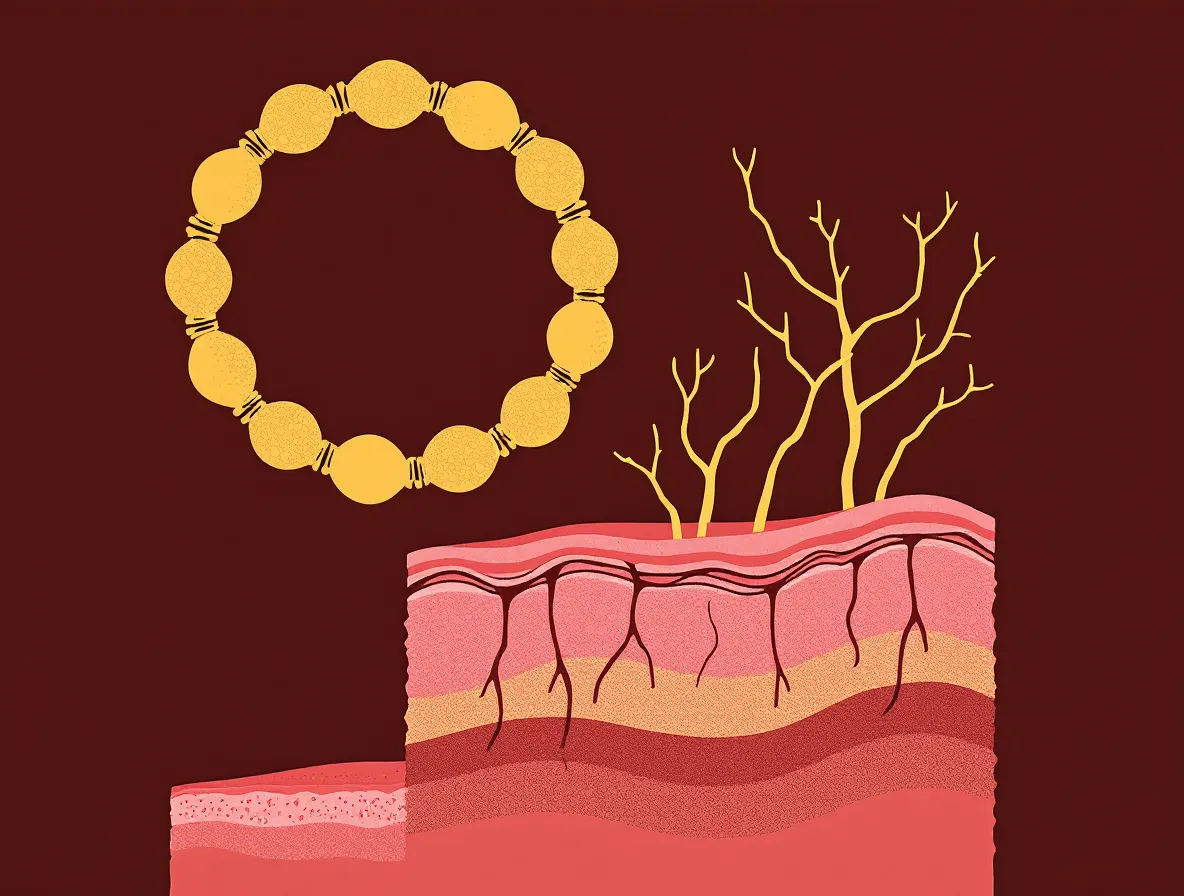
You won't find Melanotan 2 (MT-II) growing in nature. It's built in a lab. It's a peptide, which means a short string of the same building blocks your body uses to make protein, and this chain is closed into a ring. Researchers at the University of Arizona started the work in the early 1990s. They wanted a smaller, stronger version of a natural 13-amino-acid hormone that darkens your skin.
Their first questions were plain ones. Could it darken skin? Could it cause erections? Could it curb hunger? And what harm might it do? Use in people has never been approved. The evidence on Melanotan 2 in people rests on two small sets of trials and some later case reports. In 1996, Dorr gave it to 3 healthy men [1]. The Wessells trials of 1998/2000 took in 10 men and then 20 men [2][3]. Animal work added injured nerves [13], insulin [12], hunger [6] and hormones [14].
You could fit every one of those men around a couple of kitchen tables.
In the 1996 study, Dorr gave MT-II with a needle under the skin, at 0.01–0.025 milligrams for every kilogram of a man's weight. Within two weeks, two of the three men had darker skin [1]. They also had erections nobody expected, and that turned researchers toward a brain switch tied to sex drive [18]. A later trial enrolled 20 men with erection problems. At 0.025 milligrams for every kilogram, 17 of the 20 had an erection with no sexual touch at all. The tip stayed more than 80% firm for 41 minutes on average [3].
You can think of MT-II as a key that fits four different switches on your cells, which scientists call receptors. Each one runs a different job, so on this site you'll see them called the skin switch, the appetite switch, the sex-drive switch and the gland switch. When a drug flips many switches, you get many effects, wanted and unwanted. That broad reach may be one reason no drug maker ever carried MT-II through the large final trials a drug needs before approval. The four switches MT-II reaches are explained one at a time on the research page.
What Melanotan 2 changes in skin without sunlight
How does it darken your skin? It turns on the skin switch, which sits on your pigment-making cells. Your body's own tanning hormone, which scientists call alpha-MSH, uses that same switch. Once the switch is on, a chain of messages inside the cell starts making melanin, the brown pigment in your skin. None of this needs sunlight.
In his 1996 study, Dorr gave five small shots over ten days. Two of the three men had more color within two weeks [1]. The men with lighter skin changed the most, so if your skin is fair, you'd expect a bigger change. In 2021, Gilhooley read 623 online posts from 205 people who used MT-II [7]. They wrote about tanning, getting lean for fitness events, dark spots and bad batches. You're reading what people posted about their own use. No study checked those posts against a group that went without.
The same switch raises a worry. It may also push pigment cells to multiply. One report described unusual moles that grew fast [20], in a person who already had a history of such moles. Another report found melanoma, the most serious skin cancer, in a 20-year-old woman [9]. She had used tanning beds during the same weeks. Reports like these can't prove MT-II caused the cancer.
How long does the color last? The 1996 study still saw color after the shots stopped [1], but it didn't measure how fast the color faded. Animal work points to a slow fade over weeks or months.

What Melanotan 2 was made to do
Why was Melanotan 2 made? Two University of Arizona scientists, Victor Hruby and Mac Hadley, set out to copy alpha-MSH, your body's own tanning hormone, and make the copy stronger and longer-lived. That natural hormone is a 13-amino-acid chain. Their version is shorter and closed into a ring.
In your body, the tanning hormone does more than color your skin. It also plays a part in how you use energy and in your sexual response. MT-II copies those jobs, only harder. It also reaches all four switches, where your natural hormone works mainly on two: the skin switch and the sex-drive switch in the brain.
Nobody grows MT-II in a living thing. Lab workers join the building blocks one at a time, then join the chain's two ends so it forms a ring. It has never been approved for use in people like you.
What Melanotan 2 is made from
What is Melanotan 2 made of? It's made of amino acids, tiny building blocks that make up every protein in your body, joined in a short chain. None of it is taken from plants, animals or people.
The ring is what makes it tough. Your body has enzymes, chemical scissors that cut proteins apart, and a ring is harder for them to cut. The makers also swapped one building block for its mirror-image form, which the scissors don't grip as well. In rat blood, the natural hormone lasts about ~10-15 minutes. The lab-made ring lasts about one hour. You can see why the makers wanted the ring: it lasts several times longer.
If you saw it in a study lab, you'd see a freeze-dried powder. In the studies, staff mixed the powder with sterile water or sterile salt water before use. That tells you what the papers did. It isn't a set of steps for anyone at home.
What Melanotan 2 was tested for, and where that led
Researchers tested Melanotan 2 for four main jobs. Could it darken skin without sunlight? Could it help men with erection trouble [2][3]? In animals, could it curb hunger and weight [5][6]? And could it help nerves heal after an injury [13]?
In 2005, Hadley told how the sex research began [18]. Men in the tanning studies had erections, and the sex-drive switch became the main target of the human trials that followed. Those trials compared MT-II with a placebo, a dummy shot with no drug in it, so you could tell the drug's effect from chance. In rats, long use kept weight down, and brown fat gave off 3-fold more heat over a 40-day study [5]. You're reading a rat result there, not a human one.
None of this led to approval for MT-II. Two cousin drugs did get approved. Bremelanotide (PT-141), which came out of the sex-drive work, got FDA approval in 2019 for women before menopause who have low sexual desire. Afamelanotide (MT-I), from the skin-switch work, was approved by European regulators for a rare inherited condition in which daylight hurts the skin. Neither approval covers MT-II, however close the family tie looks to you.